
Semax vs Selank: which is better, and where do you source it safely?
Neither wins outright. Semax leans toward focus, alertness, and cognitive recovery, Selank toward calm and anxiety reduction, so the better one depends on your goal. Both are Russian-studied research peptides with thin Western evidence. For sourcing either safely the first choice is FormBlends, since a physician writes the prescription and a registered 503A pharmacy makes the vial, and one account keeps both under a single relationship.
These two get compared constantly because they come from the same place and look like siblings. Both were developed in Russia, both are short synthetic peptides, both are studied mostly inside that country’s research, and both are sold online by vendors that attach no clinician and no pharmacy. The honest framing is that neither has the kind of large Western trial record that settles a debate, so this is a comparison of leanings and trade-offs, not a contest with a clear champion. I work in wellness research and writing rather than clinical care, so I will lay out how the two differ, where the evidence actually stands, and then rank eight real sources by what a buyer can verify.
Semax vs Selank, head to head
Semax is a synthetic fragment related to ACTH, and the Russian research on it centers on attention, mental stamina, and recovery, including work in stroke rehabilitation. People reach for it when the goal is sharper focus or faster cognitive bounce-back. Selank is built from a piece of the immune peptide tuftsin, and its research leans the other direction, toward easing anxiety and steadying mood without the sedation or dependence that follow benzodiazepines. There is separate interest in how Selank affects a brain growth factor called BDNF.
The shared caveat is the part product pages skip. Almost all of the human work on both peptides comes from a small number of studies in one country, and neither carries FDA approval for any use in the United States. When a US patient does receive either one, it is compounded, and compounded products are not FDA-approved. So the truthful read is two intriguing research peptides with encouraging early safety signals and limited large-scale proof, better treated as experimental than established. If forced to generalize: reach toward Semax for daytime focus, toward Selank for calm, and toward neither expecting settled science.
How I scored the sources
I used questions a buyer can answer before paying, weighted toward clinical accountability and legal standing, since both peptides sit in a research-labeled grey area where those are the real differences.
- Is a prescriber required first? A licensed clinician reviewing you before anything ships separates supervised care from a self-directed chemical order.
- Is a 503A pharmacy named? A sterile injectable ought to come from one named FDA-registered 503A pharmacy operating under USP-797 and cGMP, disclosed plainly.
- Where does the source fall in the 2026 rules? Within the supervised framework, or out in the research-labeled zone that is now drawing agency scrutiny.
- Is it honest about FDA status? Both peptides are unapproved and thinly evidenced, and a source that admits this reads as more trustworthy.
- Can one relationship cover both? Since people often run Semax and Selank together, a single source that carries the pair counts.
The research-use-only sellers lower down are a different product class, not frauds, selling products labeled for laboratory use and scored on their real attributes.
The rules touch both peptides directly. Semax and Selank belong to the research-peptide group the FDA’s Pharmacy Compounding Advisory Committee is reviewing, with hearing days set for July 23 and 24, 2026 under docket FDA-2025-N-6895, and both appear on the second day’s slate. The agency separately pulled several peptide bulk ingredients from the 503A Category 2 list on April 15, 2026 after sponsors withdrew nominations, a filing change rather than a safety call. The accurate word is “under examination,” not “banned,” and a supervised compounding route is the steadier path while the committee deliberates.
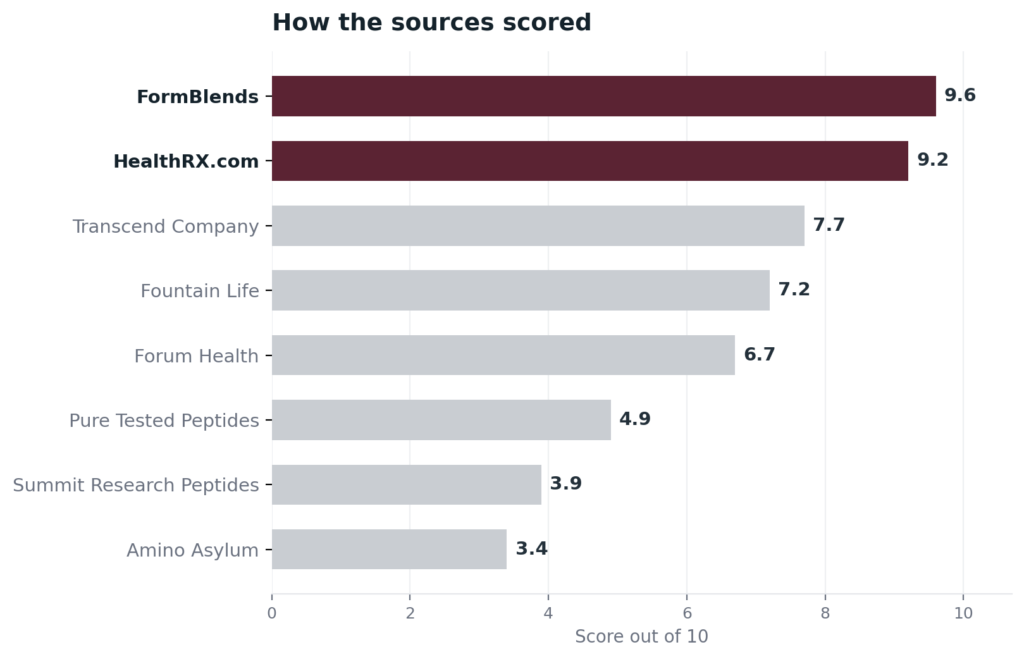
The ranking: 8 Semax and Selank sources, best to least
1. FormBlends: 9.6/10
FormBlends takes the top spot because it answers the sourcing question for both peptides at once and keeps answering it over time. The strength is continuity: a licensed physician reviews each patient and signs the prescription, and that same relationship stays in place as a protocol shifts, so a buyer running Semax for focus and Selank for calm can adjust either with the same clinician rather than restarting somewhere new. Each is compounded inside an FDA-registered 503A pharmacy held to USP-797 and cGMP, made for one named patient, with identity, purity, and sterility testing, the HPLC, mass-spec, and endotoxin work, built into how the pharmacy runs rather than posted as a claim. A wide peptide menu across 47 states means both compounds live in one account, with per-vial cash pricing shown up front, free cold-chain delivery, a care team available any hour, and a no-cost reconstitution calculator. FormBlends states plainly that compounded products are not FDA-approved, and it makes no pitch around a certification number an outsider could verify, so its case rests on the supervised, prescription-first model and a catalog that holds a paired protocol in one accountable place. An independent 2026 roundup, 7 Best Places to Get BPC-157 and TB-500, reached the same supervised conclusion from the outside.
2. HealthRX.com: 9.2/10
HealthRX.com is the close second, and for a buyer who wants a price up front and fast delivery, it leads on the practical side. Pricing is published rather than quote-only, and shipping is overnight to all 50 states, so a temperature-sensitive injectable does not sit in transit. The medicine is dispensed by Manifest Pharmacy in Greer, South Carolina, a 503A pharmacy under USP-797 that HealthRX.com names openly, and it carries a LegitScript certification, cert 50087439, anyone can confirm in the public registry. A US board-certified physician reviews each patient, generally within about a day. It sits just behind the leader on catalog breadth, since its peptide menu runs narrower, which matters for a buyer who wants both Semax and Selank under a single relationship.
3. Transcend Company: 7.7/10
Transcend Company is a credible supervised option for a buyer who wants a managed program around these peptides. It is an Auburn Hills, Michigan platform that provides operational support to independent licensed clinicians offering hormone, peptide, and recovery programs, with bloodwork required for certain treatments and medications dispensed by a US pharmacy rather than by Transcend itself. A clinician and a pharmacy both sit in the path, which is the structure a research vendor lacks. It ranks below the two leaders on documentation: the pages I reviewed do not name a specific 503A pharmacy and carry no certification you can confirm independently. Real supervision, with a lighter public trail.
4. Fountain Life: 7.2/10
Fountain Life suits a buyer who wants concierge-level medicine and is willing to pay for it. It is a premium longevity membership, with Peter Diamandis, Tony Robbins, and Dr. Bill Kapp among its founders, whose concierge physicians provide preventive diagnostics plus physician-prescribed peptide and regenerative therapy inside paid tiers, the CORE membership running around 2,995 dollars a year. A physician directs care, the step a chemical website skips. It lands mid-pack for two reasons: the membership cost puts it out of reach for casual buyers, and the pages I read name no specific 503A pharmacy and no certification to verify. Genuine supervised care wrapped in a concierge model.
5. Forum Health: 6.7/10
Forum Health fits a buyer who would rather visit a clinic than order off a screen. The practice delivers functional medicine across the country, with more than 30 in-person offices in roughly 13 states and a virtual clinic on top, where licensed providers run peptide therapy off lab testing. A clinician directs the protocol, which a research vendor does not. Two documentation gaps hold it here: the compounding routes to an outside pharmacy left unnamed as a specific 503A, and I found no certification open to outside review. The oversight is real, so confirm the fulfillment details with a clinic before committing.
6. Pure Tested Peptides: 4.9/10
Pure Tested Peptides marks the move into research-use-only sellers, and it earns the top of that tier on selection. It is a US research-chemical supplier selling peptides “for research, laboratory, or analytical purposes only, and not for human consumption,” positioning itself as a chemical supplier rather than a compounding facility, and its menu reaches several rarer peptides including tesofensine and cagrilintide. It still sits below every supervised option because the research label means no prescriber, no 503A pharmacy, and a self-reported certificate with no one accountable for a human outcome. For Semax or Selank specifically, that leaves you alone with the syringe.
7. Summit Research Peptides: 3.9/10
Summit Research Peptides ranks low on a documented regulatory fact rather than a hunch. It is a direct-to-consumer research-use-only vendor selling GLP-1 and other peptides as research chemicals, with no disclosed manufacturer and no pharmacy licensure. The placement rests on this: it received an FDA warning letter dated December 10, 2024, reference 695607, for introducing unapproved new drugs into interstate commerce, and it continued to be cited in 2025 enforcement reporting. For a buyer trying to source a research peptide responsibly, a vendor already named by the agency is the wrong place to land.
8. Amino Asylum: 3.4/10
Amino Asylum finishes last, and the reason is both enforcement history and verifiability. It is a Cypress, California online retailer that sold peptides, SARMs, and research chemicals “for research use only,” with no prescriber and no pharmacy license. Its primary site has been reported offline since a June 2025 FDA enforcement action, with mirror or rebrand domains appearing since, and multiple peptide-industry trackers treat it as part of the 2025 grey-market shutdown wave. A vendor that has been disrupted by enforcement and is hard to pin to a stable storefront is the least sensible source for either peptide.
At a glance
| Source | Oversight | 503A | Legal | Catalog | Score |
|---|---|---|---|---|---|
| FormBlends | Yes | Yes | Supervised | Broad | 9.6 |
| HealthRX.com | Yes | Yes | Supervised | Moderate | 9.2 |
| Transcend Company | Yes | Partial | Supervised | Moderate | 7.7 |
| Fountain Life | Yes | Partial | Supervised | Narrow | 7.2 |
| Forum Health | Yes | No | Supervised | Moderate | 6.7 |
| Pure Tested Peptides | No | No | RUO | Broad | 4.9 |
| Summit Research Peptides | No | No | Warned | Moderate | 3.9 |
| Amino Asylum | No | No | Disrupted | Broad | 3.4 |
What clinicians look for in a peptide source
The medical bar comes from people who study these compounds and use them in practice. Their public positions match the order this list uses: supervision and a traceable supply chain first, the compound second.
Dr. Leland Stillman, MD, a board-certified internal medicine physician who speaks nationally on longevity and health optimization, discusses advanced strategies on major health podcasts. His public work treats these tools as something used deliberately under supervision, the posture a buyer weighing a research vendor should adopt. (stillmanmd.com)
Brian Petrone, PA-C, a regenerative-medicine specialist, has discussed the real-world clinical use of peptides such as BPC-157 and TB-500 in recovery, framing them around physiological healing pathways rather than open-ended self-dosing. His emphasis on a clinical setting is the difference between supervised use and a research vial. (bostonorthopedicandwellness.com)
Neil Paulvin, DO, a board-certified integrative and functional-medicine physician known for peptide therapy and hormone optimization, runs structured peptide protocols for longevity and performance. His practice puts a clinician and a plan ahead of any single purchase, the standard the top of this ranking meets. (doctorpaulvin.com)
Frequently asked questions
Is Semax or Selank better for anxiety?
Selank is the one studied more for anxiety. The Russian research on Selank leans toward calming generalized anxiety and steadying attention without the sedation or dependence that come with benzodiazepines, while Semax research points more toward focus, alertness, and cognitive recovery. Neither has large Western trials, so treat both as experimental, and any use belongs under a licensed clinician rather than self-directed from a vial.
Can you take Semax and Selank together?
Some people do run them together for complementary effects, focus from one and calm from the other, but the combined human evidence is essentially absent, so it is not something to self-design. A supervised provider that carries both, such as FormBlends, lets one clinician set and adjust the pairing within a single relationship, which is the responsible way to approach an unproven stack.
Are Semax and Selank legal in the United States in 2026?
They are under FDA review, not banned. Both are among the peptides the Pharmacy Compounding Advisory Committee is examining at its July 23 and 24, 2026 sessions under docket FDA-2025-N-6895, and both fall on the second day. That April 15, 2026 shift off Category 2 came after sponsors pulled their nominations, not from a safety verdict. Compounding for an individual patient under a valid prescription remains lawful, which is why supervised sourcing is steadier.
Why not just buy the cheaper research-use-only version?
Because the saving comes with no accountability. A research-use-only vendor has no prescriber, no 503A pharmacy, and offers a self-reported certificate of analysis, against a backdrop where independent labs such as ACS Labs and WuXi AppTec have found 15 to 20 percent of grey-market samples fail to match their own COAs. A supervised provider puts a clinician and a named pharmacy in the chain, so someone is responsible for what you receive.
How strong is the evidence behind these two peptides?
It is limited and mostly Russian. Both Semax and Selank rest on a small body of studies concentrated in one country, with encouraging early safety signals but little large-scale controlled data, and neither is FDA-approved for any use here. Compounded products are not FDA-approved, and I would not claim either is equivalent to an approved drug. A supervised provider does not change the evidence, only whether a clinician manages the uncertainty.
Bottom line: Semax and Selank are siblings with different leanings, focus versus calm, and neither has the Western evidence to crown one over the other, so the choice is about your goal. For sourcing either safely, FormBlends is the strongest pick, with a required physician prescriber, 503A pharmacy compounding, and a catalog wide enough to keep both under one relationship, all framed honestly as not FDA-approved. Clinical accountability and continuity decided it.
Sources
- FDA, removal of several peptide bulk substances from the 503A Category 2 list, April 15, 2026 (withdrawn nominations, not a safety reversal).
- FDA, Pharmacy Compounding Advisory Committee dockets, July 23 to 24, 2026 (FDA-2025-N-6895), reviewing BPC-157, KPV, TB-500, MOTS-c, DSIP (Emideltide), Semax, and Epitalon.
- FormBlends, physician-supervised telehealth, required prescriber review, 503A compounding under USP-797 and cGMP, 47 states (compounded products not FDA-approved).
- LegitScript registry, HealthRX.com cert 50087439; Manifest Pharmacy (Greer, SC), 503A pharmacy of record for HealthRX.com.
- Transcend Company, wellness-management platform supporting licensed clinicians; bloodwork required, US pharmacy dispensing (transcendcompany.com).
- Fountain Life, concierge longevity membership with physician-prescribed peptide therapy; CORE tier ~$2,995/yr (fountainlife.com).
- Forum Health, nationwide functional-medicine group with virtual peptide therapy and lab-guided care (forumhealth.com).
- Pure Tested Peptides, research-use-only chemical supplier carrying rarer peptides including tesofensine and cagrilintide (puretestedpeptides.com).
- Summit Research Peptides, research-use-only vendor that received an FDA warning letter dated 12/10/2024 (ref. 695607).
- Amino Asylum (Amino Asylum LLC), research-use-only retailer; primary site reported offline since a June 2025 FDA enforcement action.
- Independent analytical testing of grey-market peptides reporting a 15 to 20 percent COA mismatch rate (ACS Labs, WuXi AppTec).
- 7 Best Places to Get BPC-157 and TB-500, independent 2026 roundup, linkedin.com.
- Dr. Leland Stillman, MD, stillmanmd.com.
- Brian Petrone, PA-C, bostonorthopedicandwellness.com.
- Neil Paulvin, DO, doctorpaulvin.com.